Digital Marketing for Construction Companies.
Commercial and residential contractors do not lose jobs at the quote. They lose them in the ten minutes after a referral, when the buyer types your name into a phone and decides whether you look like a company that can handle a six figure project. This page is about winning that ten minutes, and about being findable by the buyers who never got a referral at all.
The Referral Gets You Looked Up. Your Website Decides Whether You Get Called.
Almost nobody hires a contractor cold, and almost nobody hires one on the referral alone either. Somebody gives them your name, and then they check. They search it, they open your site, they look at your Google profile, they read a couple of reviews. That check is where the referral is either confirmed or quietly dropped, and you never hear about the ones that get dropped.
A Bad Site Costs You Credibility and Traffic
On a $400 job, an old website is a minor annoyance. On a $150,000 build it is evidence. A buyer about to hand you more money than they have ever handed a stranger reads a broken, dated, phone unfriendly site as a company that either has no work or cannot manage the details. The judgment is unfair, and it is being made anyway.
Being Findable Is What Closes the Referral
If your name returns nothing, that is worse than a mediocre result. The person doing the checking has no way to confirm you exist, and they are one text away from asking their neighbor for a second name. A real site, a complete Google profile and a few current reviews turn a recommendation into a phone call.
They Are Comparing You to Two Other Bids
You are almost never the only contractor being looked at. The other two are being checked the same way, on the same phone, in the same sitting. That is the real competitive set, and most of it is decided before anyone reads your number. Whoever looks the most established at that moment gets the call first, and the other two get a voicemail they never return.
A Six Figure Job Is Not Bought in an Afternoon.
Emergency trades get found and hired in eleven seconds. A commercial buyer may start looking a year before the work happens, and a homeowner planning an addition will sit with the idea through two winters. Marketing built for an instant decision misses every one of them, because it stops the moment the phone does not ring.
- The ideaSomeone starts thinking about the project. They are reading, looking at photos, working out roughly what this costs. They are not going to call anybody yet. This is where content and project galleries do their work, and where almost nobody bothers to show up.
- The shortlistNow they are collecting names, from referrals, from search, from a sign on a job site. They visit three or four websites in one sitting and cut the list to two or three. Nothing sells at this stage. The site's whole job is surviving the cut.
- The bidRequests go out. This is the only stage most contractors are set up for, and it is the shortest one. If the form is hard, the reply is slow, or the buyer cannot tell whether you do this type of work, you drop out here after doing everything right up to it.
- The gapWeeks, sometimes months, of quiet while financing, permits, a board or a spouse catch up. Most contractors go silent here and lose jobs they already won on merit. A basic follow up sequence, which is CRM work, is the cheapest recovery on this whole page.
The practical point: a lead that goes quiet for two months is not a dead lead, it is a normal one. Judge this work on a season. That is also why we will not sell a construction company a plan that has to prove itself in thirty days.
Project Photos Sell the Job. Everything Else Supports Them.
Nothing you can write outperforms a photo of a finished job. A buyer cannot judge your framing, your crew or your schedule, but they can look at a completed roof, a poured slab or a finished kitchen and decide in about a second whether that is the standard they want. Construction is one of the few trades where the proof is genuinely visual, and most contractors leave it on a phone.
Shoot Before, During and After
The after photo is the one you want to post. The before photo is what makes it mean something, because it is the only way a stranger can see what you changed. Shoot from the same spot both times. That single habit is worth more than a camera upgrade.
The during shots have their own job. They show a clean, organized site, which is exactly what a commercial buyer worries about and never asks out loud.
A Photo Is Also a Search Signal
Named properly, filed on the right project page and posted to your Google Business Profile, they tell Google what type of work you do and which towns you do it in. It is one of the few things that helps the buyer and the ranking at the same time.
This is also the one part we cannot do for you. We can build the pipeline, name the files, write the captions and get them published on a schedule. Somebody on your crew still has to take the picture before the site gets cleaned up.
The waste we see most often is a company with fifteen years of finished work and eight photos online, half of them stock. If you have an archive sitting on old phones and a hard drive, that is a marketing asset you already paid for. Our web design work starts by getting it out of there and onto real project pages.
The Request Form Is the Product. Build It Like One.
Everything else on this page exists to deliver somebody to a form or a phone number. Most contractor sites then hand that hard won buyer a generic contact box that asks for a message and says nothing about what happens next. This is the cheapest thing here to fix and the one with the shortest payback.
Sort Commercial From Residential First
These are two buyers with two different jobs to describe. Give each one its own path from the first click. A property manager who lands on a page about kitchen remodels assumes you are not their contractor, and leaves without ever telling you. The same page loses a homeowner the other way, and neither of them ever shows up in your numbers as a job you missed.
Ask Enough to Qualify the Job
A photo upload field does more work than any other input on a quote form. It lets the buyer explain a problem they have no words for, and it lets you scope before you drive out. Pair it with the project address, the project type, a description and an estimated date. Those fields cost you a few submissions, and the ones they cost you are the tire kickers and the spam that were never going to book.
Say What Happens Next
One line, above the button: who calls, how fast, and whether the visit costs anything. Uncertainty is what stops a submission on a large job, because sending the form feels like starting something the buyer cannot see the end of. Naming the next step removes that, and the fix is a sentence.
Answer Before the Other Two Bids Do
Speed of reply beats almost everything else at this stage, and it is a systems problem. Nobody on a roof can watch an inbox. A text alert the moment a request lands, plus an automatic acknowledgment to the buyer, is standard automation and CRM work, and it buys back the hours between a form arriving and somebody seeing it.
Where You Will Take a Job Is Not Where Google Shows You.
Two realities shape every construction campaign, and both get ignored by marketing built from a national template.
Your Real Radius Is Smaller Than Your Map
Ask a contractor how far they travel and you get a forty five minute answer. Ask which jobs are profitable at that distance and the number shrinks fast, because crew time, hauling and a second trip for the punch list all come out of the same margin. Rivers, highways and bridges decide what is reachable, so two jobs the same distance out can be an hour apart. Around Pittsburgh the Allegheny, the Mon and the Ohio cut the map into corridors, and a job across a valley is nothing like a job the same distance up one.
Google's local pack ranks heavily on proximity, so you will not appear across the county no matter what anybody sells you. The half you can win is organic: real pages for the towns you want work from, which can rank there without an office in them. That is local SEO, and it is the honest version of covering a service area.
Seasonality Moves the Work, Not the Demand
Exterior work compresses into the warm months, so a spring rush and a winter trough are normal. The mistake is treating the marketing as seasonal too. Search work is paid forward: pages and photos published in February are what rank in May, and a campaign switched off in November starts from behind in March. The quiet months are when the pages get written and the profile gets filled out, because that is the only stretch of the year with time in it. Crews that go dark until spring spend the first six weeks of the season buying back a position they already had.
The quiet months are also when you finally have time to publish the season you just finished. Interior work, storm damage and emergency repairs keep running cold, and they deserve their own pages.
Put the Boring Credentials Where a Nervous Buyer Can Find Them.
Contractor fraud is the thing every homeowner has been warned about, and commercial buyers have a procurement checklist that asks the same questions in a colder font. These details feel like paperwork to you. To the person about to write the check, they are the difference between a real company and a truck.
State Registration and License Numbers
Pennsylvania home improvement contractors carry a registration number. Print it. A buyer who wants to verify it can do that in a minute, and the ones who check are usually the ones with the larger projects.
Insurance, Bonding and Workers' Comp
Say plainly that you carry liability insurance and workers' compensation, and that a certificate is available. Commercial buyers will ask for it anyway. Answering before they ask removes a step and reads as a company that has done this before.
Years, Crew and a Real Address
How long you have been in business, whether the crew is yours or subbed out, and a real address. Every one of these is a question a buyer has and will not ask out loud.
Reviews sit in the same category. A buyer checking you after a referral reads the recent ones and your responses, not the average. Keeping that current is ongoing work, and it is what reviews and reputation covers.
Where a Construction Company Should Usually Start.
This page lists the same services we run for everyone, ordered for how contractors get work. Every one of them carries its price on its own page.
Survive the Look Up
- ✓Web design, with real project pages
- ✓Branding that matches the trucks
- ✓Reviews and reputation
Get Found Without a Referral
- ✓Local SEO and the Google profile
- ✓Search engine optimization for service and town pages
- ✓Google Business Profile management, where the job photos go
Fill a Slow Month
- ✓Google Ads for the buyers already searching
- ✓Meta Ads for the ones still thinking about it
- ✓Automation and CRM for the long gap between bid and start
We Already Work With Multiple Construction Companies in the Valley.
Greece Contracting is a commercial and residential construction company in the Vandergrift area, about forty minutes up the Allegheny from Pittsburgh. Forty years across construction, roofing, siding, windows, flooring and concrete, which means their site has to sort a homeowner from a commercial buyer before anybody picks up the phone. Mottillo Concrete and Construction is the other, in Apollo, where the work is poured rather than framed and the site is built to show it.
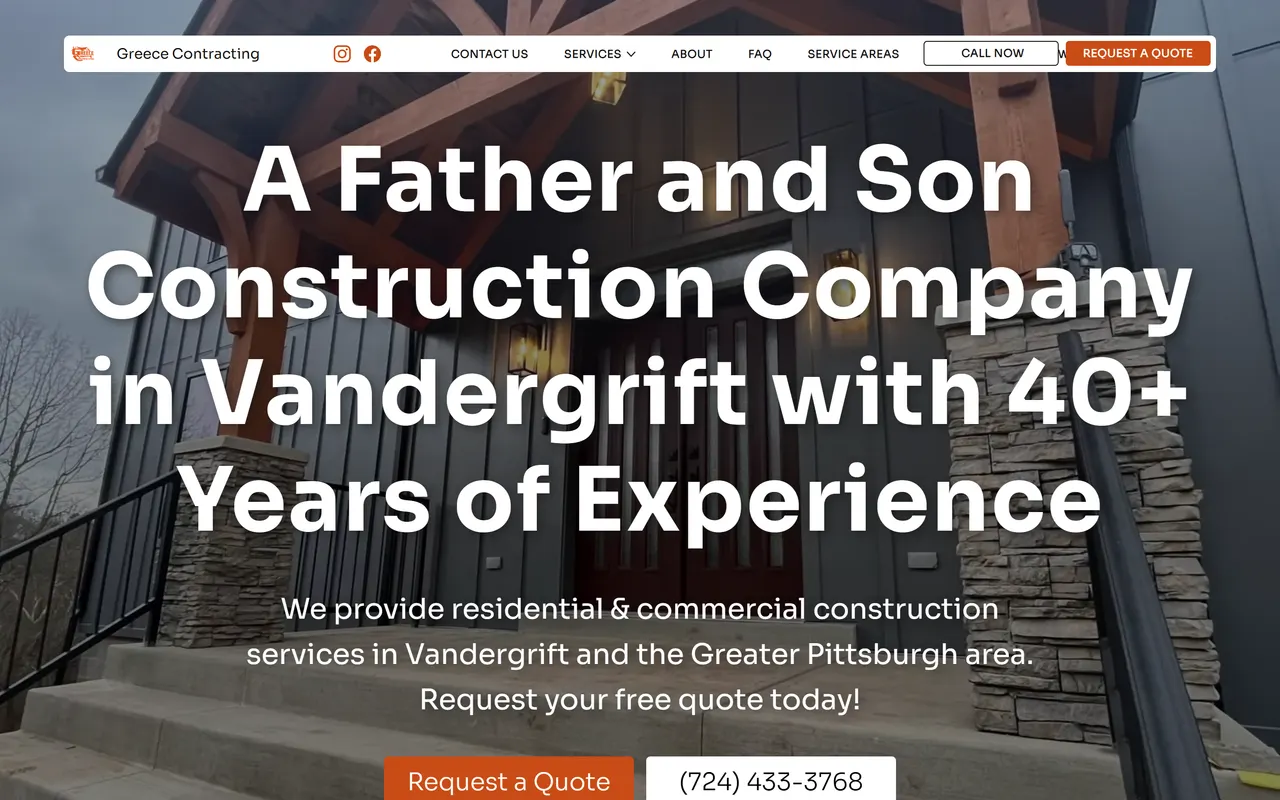
Greece Contracting
Commercial & Residential Construction · VandergriftWebsite and Google Business Profile. Services and service areas both get real pages, so a commercial buyer and a homeowner each land somewhere written for them. The profile is the ongoing half: job photos, services and categories kept current.
Open greececontracting.com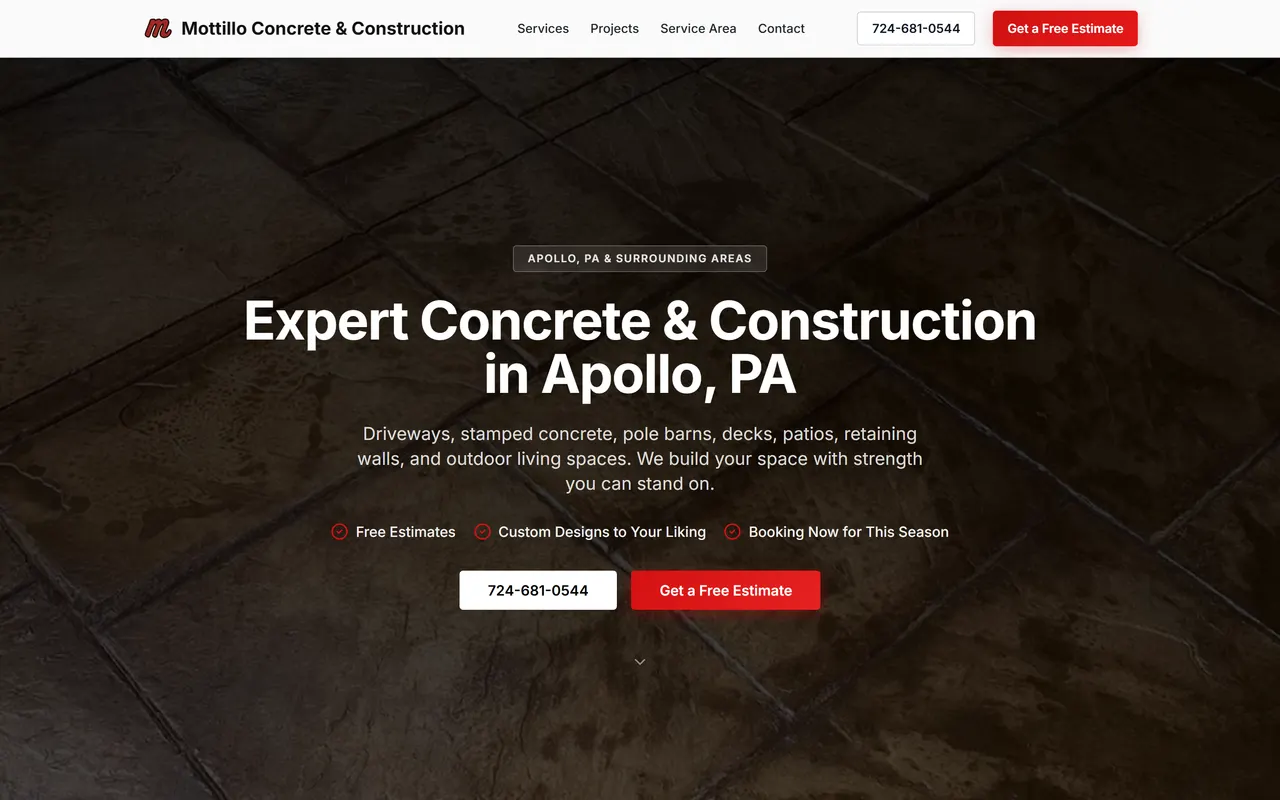
Mottillo Concrete and Construction
Concrete & Construction · ApolloWebsite and Google Business Profile. Concrete sells on what it looks like finished, so the build is mostly a project gallery with a free estimate attached to it. Driveways, stamped patios, pool decks, retaining walls and built-in fire pits, each shot as its own entry.
Open mottilloconcreteandconstruction.comThe site is live and the profile is the ongoing half of the job: new job photos as the work comes off the truck, the service list kept in step with what they take on, and the categories and service areas matched to the towns they cover.
Questions Contractors Ask Us First.
Do you work with commercial contractors or only residential?
Both, and most contractors are both. The work is separating them on the site.
A homeowner pricing a kitchen and a property manager pricing a roof replacement want different proof, different language and different next steps. Put them on one page and you write something vague enough to lose both. So each side gets its own page, its own photos and its own request form.
How long before a construction website starts producing work?
The credibility half works immediately. From the day a good site is live, every referral who looks you up finds something that backs up what they were told, and that is happening today whether or not you built for it.
The search half is slower. Three to six months before you hold position against contractors who have been at this for years. Anyone promising the top three in thirty days is either lying or working in a town with no competition.
Do I really need professional photos of my projects?
You need real photos of your own work far more than you need professional ones. A clear phone photo of a job you finished beats a stock image of somebody else's building every time, because the buyer is looking for evidence.
The habit matters more than the camera: shoot before, shoot during, shoot after, and shoot the same job from the same spot. If you want a full shoot for the flagship projects, that is worth doing once you have the habit.
What should a quote request form ask for?
Enough to qualify the job before a truck leaves the yard. Name, phone number, email, the project address, the project type, a project description, an estimated project date, how they heard about you, and a marketing consent box.
A three field form will get you more submissions. It will also get you tire kickers, spam, and people who will not say what they want built. The longer form is the filter, and the leads that come through it arrive already qualified, so the ones you do call are worth the drive. Somebody who will not spend ninety seconds describing a project they want priced was never going to sign a contract, and screening them out at the form is far cheaper than screening them out in a driveway.
What should I do in the slow season?
Two things. Spend the quiet weeks publishing the work you did all season, because the photos and project pages you build in February are what rank in May, and search work is always paid forward.
Then keep the winter services visible on their own pages, so the trades that do run cold, interior work, storm damage, emergency repairs, are findable when someone needs one.
Do you work with any construction companies now?
Yes. Greece Contracting is a commercial and residential construction company in the Vandergrift area, and we handle their website and their Google Business Profile.
Their site sorts a homeowner from a commercial buyer, with the trades they run written up as their own service pages and the towns they cover written up as their own area pages. On the profile side we keep the job photos, the service list and the categories current, so what Google shows about them matches the work they take on.
Find Out What a Buyer Sees When They Look You Up.
One conversation about the type of work you want more of, which towns you want it from, and what is on your site and your Google profile right now. We come back with specific opportunities you are missing, and you keep the list whether or not you ever hire us. If you want us to fix any of it, that is a separate conversation and entirely your call.