Meta Ads Management in Pittsburgh. We Make the Ads, Not Just Run Them.
Facebook and Instagram do not have a search bar people type their problem into. Nobody is looking for you there, which means the ad itself has to do all the work of stopping someone who was not shopping. That is the hard part, most agencies hand it back to you, and it is the part we do.
Google Waits for Demand. Meta Goes and Creates It.
Someone typing "concrete contractor near me" has already decided they want concrete. Your job on Google is to be the one they pick. On Facebook and Instagram nobody has decided anything. They are looking at their nephew's baby photos, and you have about one second to be more interesting than the next swipe. Everything about how this channel is run follows from that one difference.
Nobody Is Searching for You
There is no keyword to bid on, because there is no query. The platform decides who sees you, and the only real vote you get is what the ad looks like and what it offers. Targeting settings matter far less than people think. The ad matters far more.
The Creative Is the Targeting
Show a video of a stamped patio and the system learns, fast, who stops scrolling for stamped patios. The ad finds the audience rather than the audience settings finding the ad. This is why handing creative back to the client quietly breaks the whole thing.
It Runs on a Longer Clock Than Search
Search converts the same week because the intent was already there. Meta interrupts someone who was not thinking about you, so a share of your return shows up as a call weeks later that never gets attributed. Judge it on ninety days, not on week two.
$1,500 a Month for the Work. Your Ad Spend Is Yours.
Your ad spend is separate and goes straight to Meta on your own card, never through us and never marked up. Plan on $1,500 to $2,000 a month for it, which makes the honest all-in figure $3,000 to $3,500 rather than $1,500.
Escape Velocity
One flat fee. It does not scale with your spend, so we never make more by telling you to spend more.
- Everything in Operation Hyperdrive
- Ad Copy Written for You
- Creative Built for You, Image and Video
- Campaign Build & Account Structure
- Pixel & Conversion Tracking Setup
- Audience & Offer Testing
- Budget Managed Across the Month
- Monthly Reporting in Plain English
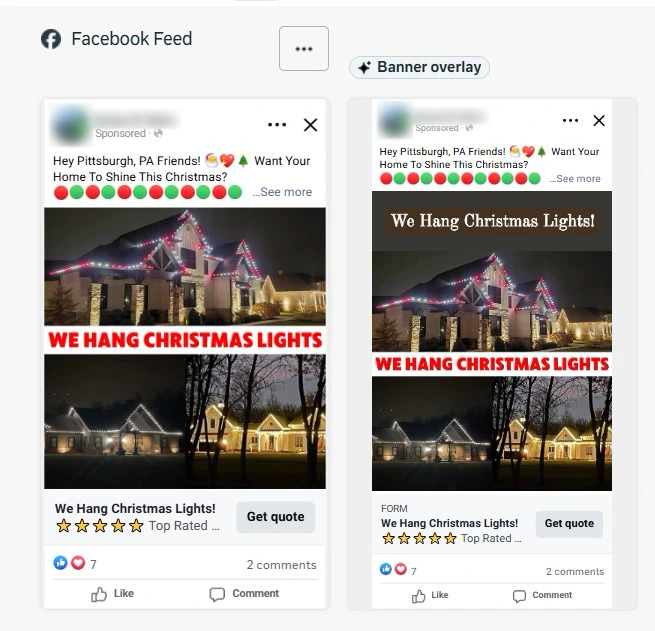
The Ad Is the Whole Job. So We Make the Ad.
Ask an agency what happens if the ads are not performing and listen for how fast they mention creative. It is the single biggest lever in this channel and it is also the one most of them do not touch, because writing and producing is work and changing a targeting setting is a click. Then the campaign stalls, and the reason it stalled is sitting in your inbox waiting for you to send photos.
We Write It
Every headline, every line of body copy, every call to action. Written against a specific offer aimed at a specific person, not adapted from your homepage. The same job that gets written for the ad usually improves the page it lands on, so both get looked at together.
We Build It
Static images, cut-down video, text overlays, the vertical formats Reels and Stories need. Built to the sizes each placement wants instead of one square dropped everywhere and cropped badly on three of them.
You Send Raw Material
Photos and clips of your real work, your real crew, your real finished jobs. A phone camera is genuinely fine. This is the one thing we cannot do from here and the one thing that makes an ad look like a business rather than a stock library, so we will tell you exactly what to shoot.
We Keep Making New Ones
An ad that works does not work forever. The same people see it too many times, it stops earning, and the cost climbs. So new creative goes in continuously rather than once at launch, which is what the monthly fee is buying more than anything else.
What Happens, and When You Should Judge It.
Nobody tells you what month two looks like, which is why month two is when people quit. Here is the shape of it up front, including the part where you are spending and it does not look like much is coming back yet.
Month One: Build and Learn
Account structure, pixel and conversion tracking, audiences, and the first round of creative going live. This month is Meta working out who responds to you. It will feel like spending without much return, because that is exactly what it is, and everything after this is built on the data it produces.
Month Two: Cut and Feed
By now some ads are clearly beating others. The losers get killed, the budget moves to the winners, and new creative goes in against whatever is currently winning. Retargeting switches on properly here, because now there is a pool of people who looked and did not act.
Month Three: The Real Read
This is the first month whose numbers are worth trusting, and the first honest conversation about whether the channel is earning. If it is, we scale the spend into what is working. If it is not, you get told that plainly rather than being managed for another quarter.
Every Month: You Get the Report
What we spent, what came back, what we changed and why, in plain English rather than a dashboard export with forty metrics and no conclusion. You also keep your own login to the ad account the entire time and can check any of it yourself.
The Ad Account Is Yours, and It Stays Yours When You Leave.
This one is worth understanding before you sign anywhere, not just with us. Plenty of agencies run their clients inside the agency's own business manager. It is quicker to set up, and it means that on the day you leave, the account, the audiences and every bit of conversion history the pixel has learned about your customers stay behind with them.
The Account and Everything in It
Your business manager, your ad account, your pixel.
We get access to yours rather than building you inside ours. Your card is on it, your name is on it, and the conversion history that makes the targeting smarter over time accumulates on your side of the line.
The creative we produce for you is yours as well. If you leave, you take the ads, the video edits and the copy with you, and you can hand the whole account to somebody else on the same afternoon.
945 Studios Removes Its Access. That Is It.
No buyout, no export request, no hostage situation.
There is nothing to transfer because nothing was ever held on our side. We come off the permissions list and every campaign, audience and asset carries on sitting exactly where it already was.
If you are currently with someone else, this is the first question to ask them, and the answer tells you most of what you need to know about the relationship.
Four Ways to Run Facebook Ads for a Local Business, Compared.
There are four realistic ways to run Facebook and Instagram ads for a local business. Worth seeing them side by side before anyone spends anything.
| 945 Studios | The cheap ads agency | Boosting posts yourself | Hiring in house | |
|---|---|---|---|---|
| Monthly cost | $1,500, flat | $300 to $700 | Free, plus your evenings | $4,000+ salary |
| Who makes the ads | Us. Copy and creative both | You, usually, once you read the onboarding form | You, from whatever is on your phone | One hire, if they can also edit video |
| Whose ad account | Yours. We get access to it | Often theirs, which you find out on exit | Yours | Yours |
| New creative after launch | Continuously, as ads wear out | Rarely, and usually only if you ask | When you remember | Depends entirely on the hire |
| What the fee scales with | Nothing. Flat either way | Your ad spend, on the percentage model | Nothing | Nothing |
| Honest best fit | You can fund $3,000+ a month all in and want it off your desk | You want a presence and are not counting the return | You have real time and want to learn the platform | You are big enough to keep one person busy on this alone |
The percentage-of-spend model is the one worth thinking hardest about. It sounds fair and it quietly puts your agency's income on the opposite side of the table from your budget, because the only lever that reliably grows their invoice is telling you to spend more. A flat fee is not more virtuous. It just removes that particular argument from the room.
Worth Saying Plainly, Before You Spend Twenty Minutes on a Call.
This Is for You If
- ✓You can fund the management fee and the ad spend together for at least three months without it hurting.
- ✓What you sell is something people can be talked into wanting, not only something they go looking for.
- ✓You can get us photos and clips of real jobs, even if they are shot on a phone in a hurry.
- ✓You can handle the enquiries if they arrive, and you would rather judge this on ninety days than on week two.
This Is Not for You If
- ✕You need a guaranteed cost per lead in writing. Nobody controls Meta's auction, and anyone who guarantees you a number is guessing in a confident voice.
- ✕You are in a category Meta restricts or bans outright. Some industries cannot advertise here properly no matter who runs the account.
- ✕You want to approve every ad before it runs. Testing means putting things live that might lose, and an approval queue kills the speed that makes testing work.
Still not sure? Hand this page to an AI that has no stake in the answer, tell it about your business, and let it tell you whether Meta ads are even the right channel for you.
Opens in ChatGPT or Claude with the question already written. We do not see the conversation, and we do not get to edit the answer.
The Things People Ask Before They Sign.
What does the $1,500 cover?
The work, plus everything in Operation Hyperdrive. Writing the ads, making the creative, building and structuring the campaigns, setting up the tracking, testing audiences and offers against each other, managing the budget across the month, and reporting what happened.
It does not cover your ad spend. That is a separate number, it goes straight to Meta from your own card, and we never touch it or mark it up.
How much do I need to spend on ads?
Most businesses we start should plan on $1,500 to $2,000 a month in ad spend, on top of the management fee.
That is not a made up floor to raise the invoice. Below a certain volume Meta's system does not get enough data to learn who converts, so it keeps guessing, and you end up paying for a test that never finishes. If your budget is well under that, say so before you spend anything and we will tell you honestly whether to wait or to put the money somewhere else first.
Do you make the ads or do I?
We do. That is the part most agencies quietly leave to you, and it is the part that decides whether any of it works. 945 Studios writes the copy and builds the creative, images and video edits included.
What we need from you is raw material: photos and clips of your actual work, your actual team, your actual finished jobs. A phone camera is fine. Real footage of a real crew beats a stock photo every single time, and we would rather coach you on what to shoot than stage something that looks like everyone else.
How long before it works?
Plan on ninety days before you judge it, and expect the first month to look like spending without much back. That is not a hedge, it is how the platform works: the first few weeks are Meta learning who responds, and the early data is what everything after it is built on.
Anyone who tells you month one will be profitable is either lucky or selling. What you should see in month one is ads live, tracking working, and a first read on which offer and which audience are worth more money.
Do I need a website first?
You need somewhere for the click to land, and it has to be fast on a phone and clear about what to do next. If you already have that, we will use it.
If you do not, sending paid traffic to a slow or confusing page is the most expensive mistake in this whole channel, because you pay for every visitor who bounces. In that case fix the page first. We build websites too, and the honest answer is often to do that before spending a dollar on ads.
What happens if it does not work?
You stop. There is no long contract, and you are never locked in past the month you are in.
What we will not do is promise you a result to win the deal, because nobody controls what Meta's auction costs next quarter or what your competitors decide to bid. What we will do is tell you early and plainly if the numbers say this channel is wrong for your business, including when the right answer is to stop paying us and put the money into search instead.
Can you run Google Ads at the same time?
Yes, and for a lot of businesses that is the better order: Google first to catch the people already looking for you, then Meta to go and find the ones who do not know you exist yet. They do different jobs and the spend does not compete.
If you can only fund one right now, tell us what you sell and we will tell you which one, including when the answer is the one that makes us less money.
Tell Us What You Sell. We'll Tell You if Meta Is the Right Room.
One conversation, no deck. What you sell, who buys it, and what you can genuinely put behind it every month. We come back with whether this channel suits your business at all, what the first ninety days would look like, and the reasoning, including when the honest answer is to spend the money on something else. Our clients are mostly around Pittsburgh, and a radius that looks generous on a map is often the reason a local campaign wastes half its budget. If you are launching from nothing, the Lightspeed launch package puts the site and the tracking up on the same day.