Digital Marketing for Hardscaping and Concrete Contractors.
Patios, driveways, retaining walls, stamped work and pool decks are bought with the eyes, months before anybody signs anything. We build the site and the search presence around that: the portfolio up front, the season in mind, and a quote form that collects photos and dimensions.
Nobody Buys a Patio in Eleven Seconds.
An emergency plumber gets found and called inside a minute. You do not. A homeowner sees a paver patio somewhere, saves a photo, thinks about it through the winter, shows their spouse, gets three quotes and signs in the spring. Marketing built for the emergency trades gets this trade wrong from the first line.
It Is a Home Improvement Project
They are not buying a repair, they are buying how the back of their house is going to look for the next twenty years. That is closer to a kitchen remodel than to a service call, and it gets shopped the same way.
The Research Runs for Months
People collect ideas long before they collect quotes. If you only exist at the moment someone is ready to buy, you were never in the running. You have to be one of the contractors they have already been looking at.
Three Quotes, Not One Call
Almost every job of this size gets compared. That means your site is read next to two competitors, on the same evening, on the same phone.
Your Photos Are the Pitch. Everything Else Is Support.
This is the part most contractor sites get backward. Paragraphs about quality and integrity are doing nothing. A homeowner wants to see a finished patio that looks like the space they are standing in, and then find out you built it eight minutes from their house.
Organized by Job, Not by Date
A gallery that is just a pile of photos makes the visitor do the sorting. Split it the way people shop: patios, driveways, retaining walls, stamped and decorative, pool decks, steps and walkways, fire pits. Somebody who wants a wall should never have to scroll past forty driveways.
Named With the Job and the Town
A file called IMG_4471 tells Google nothing. The same photo named for a stamped concrete patio in the town it was poured in tells both a search engine and a reader where the work was done. Do that a hundred times and it becomes a map of where you work.
Before Shots Are Worth More Than Afters
Every contractor has finished photos. Far fewer have the cracked, sunken, weed grown before. That pair is the single most persuasive thing on a hardscaping site, because it shows the homeowner their own yard on the left.
Fast Enough to Scroll
A photo heavy site is exactly the kind that ends up slow, and a slow gallery on a phone loses the visit before the third image. The photos get compressed properly and loaded as they are reached, so the gallery stays fast.
If the photos are the product, they are worth doing properly. Real shots of your own crews and your own finished work beat anything bought from a stock library, and homeowners can tell the difference immediately. Web design is where this gets built.
In a Freeze and Thaw Climate, They Decide in February and Pour in May.
This trade has a hard seasonal wall that most marketing plans ignore. Anywhere winter is real, the pour window closes when the ground freezes, and that is a date on the calendar. The money question is when the decision gets made.
- Late FallThe season is winding down and this is the cheapest, quietest time to fix the foundation of everything else. The site, the profile, the galleries from the year you just finished. Work published now has months to settle in before anyone starts shopping.
- WinterIdea gathering. Nobody is pouring, but plenty of people are sitting inside looking at patios. This is when you want to be findable and worth saving, even with the trucks parked.
- Late Winter and Early SpringThe decision window. Quotes get requested, three contractors get compared, and the calendar fills. Whatever you are going to rank for this year, you needed to rank for it before this point. Starting the work here is starting it late.
- Spring and SummerYou are building. Marketing shifts to keeping the pipeline honest and photographing everything you finish, because this year's jobs are next winter's portfolio.
The practical consequence: going quiet in the off season is the most expensive habit in this trade. Search work takes months to move, so the contractor who paused in November is arguing for scraps in March against the one who did not.
Ranking at Your Own Address Is Not the Same as Being Found Four Towns Over.
Google Maps is where most of this work is won, and it is decided inside a tight radius. Search your own trade standing in your shop and you will look fine. Drive fifteen minutes into the township you want work from and you may not be on the map at all.
Why Your Radius Lies to You
Proximity is one of the things Google weighs, and it is the one nobody can change. You do not have a ranking, you have a different ranking from every street. That is why the phone can feel quiet while the profile looks healthy.
It is also why a competitor with worse work can be beating you in one town and losing to you in the next. You are just standing in different places.
What Reaching Further Takes
Real pages for the towns you drive to, jobs photographed and named in those towns, reviews from customers who live there, and the slow authority work that makes Google confident enough to show you outside your own zip code.
It works, and it is not fast. Anyone selling you a whole county in thirty days has not told you which part they are leaving out. Local SEO is the service that does this, and both prices are published on its page.
Half Your Customers Are Searching for the Wrong Term.
You call it hardscaping. A good number of homeowners call it landscaping, and a good number call concrete cement. Somebody who wants a paver patio may type "backyard patio companies", "masonry", "landscaper" or the name of a material they saw on a home improvement show. They are still your customer.
The Landscaping Overlap
Landscaping and hardscaping get used interchangeably by the people paying for both. Some contractors do both, most specialize, and the searcher has no idea which one they need. A site that only speaks in trade terms filters out the customers who did not know the trade term.
Material Words Carry Real Intent
Stamped, exposed aggregate, pavers, flagstone, block, poured. Somebody typing a material has already decided what they want and is looking for whoever does it. Those searches are small and they are worth more than the broad ones.
Your Profile Categories Decide a Lot
The Google Business Profile category is one of the fastest levers in local search and it is routinely set once and never checked. A hardscaping company filed under the wrong primary category is fighting with one hand tied.
The fix is writing pages in the words homeowners really use, and setting the profile categories and services so you appear on the search a normal person makes. That is profile work and page work together, and neither one does much alone.
A Lead Without Photos and Dimensions Costs You a Truck Roll.
Most contractor forms ask for a name, an email and a message box. Then you drive out to look at a job that was never going to happen, on a day you could have been pouring. The form is doing half its job.
What the Form Should Ask For
- ✓Photos of the space, uploaded from the phone they are already holding.
- ✓Rough dimensions, even if they are pacing it out. Approximate beats nothing.
- ✓The job type, so a wall does not arrive labeled as a patio.
- ✓The town, because your drive time is part of your price.
- ✓When they want it done, which sorts this season from next.
Why This Pays for Itself
A quote request with five photos and a rough square footage can be scoped before you get in the truck. You can price the obvious ones, ask one question on the ones you cannot, and spend site visits on jobs that are real.
It also tells the homeowner you are organized, which is most of what they are trying to work out from a form. Then the reply speed decides the rest. In a three quote race, the first honest answer wins an unreasonable share of the time, and that is what automation and CRM is for: the lead hits your phone the second it lands.
Cheap Work Fails Visibly, and Everyone in Town Sees It.
This is the trade's real marketing problem. A bad concrete job does not fail quietly. It cracks, heaves and spalls where the neighbors can watch, and in a cold climate it takes about two winters. Every homeowner shopping for a patio either has that story or has heard it, and they are shopping scared.
What Reassures People
Show the parts nobody photographs: the excavation, the base, the compaction, the rebar or mesh, the control joints, the drainage behind a wall. The homeowner will not understand all of it and does not need to. They need to see that you know it exists.
Old work is the other half. A patio photographed the week it was finished proves nothing. The same patio five years later proves everything.
Say the Freeze and Thaw Part Out Loud
Any climate that crosses above and below freezing all winter is what destroys badly built concrete and poorly drained walls. Western Pennsylvania is one version of it, and so is every market with a real winter. A page that explains why the low bid fails in your climate does more for you than any claim about quality, because it teaches the buyer how to spot the contractor you are competing with.
Reviews close the loop. A steady flow of them, answered like a person, is the strongest third party signal you have, and it is also a ranking factor. That is reviews and reputation.
Four Things, in This Order.
Every one of these is a service with its own page and its own published price. Nothing here is held back for a call.
Build the Portfolio Site
Photos first, sorted by job type, fast on a phone, with a quote form that asks for images and dimensions. Web design.
Fix the Google Profile
Categories, services, service area, and a photo set named for the work and the town. The fastest lever in local search and usually the one nobody has checked. Profile optimization.
Reach Past Your Own Address
Town pages, job pages, citations and authority work, so the map shows you in the places you are willing to drive to. Local SEO.
Answer Fast and Ask for Reviews
Instant alerts on new quote requests, and a review request that goes out while the customer is still standing on the new patio. Automation and CRM, reviews and reputation.
We Build the Site and Run the Google Profile for a Concrete Crew in Apollo.
We work with Mottillo Concrete and Construction, a concrete and construction company in the Apollo area, northeast of Pittsburgh. Driveways, stamped patios, pool decks, retaining walls and fire pits, sold the way this trade is sold: a project gallery with a free estimate attached to it.
That build is the same shape we would give you. Finished jobs go up as gallery entries with the town named on them, the service pages are written in the words homeowners type, and the Google Business Profile carries the categories, the service list and the fresh job photos so the map listing and the site tell one story instead of two. The estimate request is the only thing we ask the homeowner to do, and it is never more than a tap away.
Everything on this page is how this trade gets bought, and what we would do about it in your market.
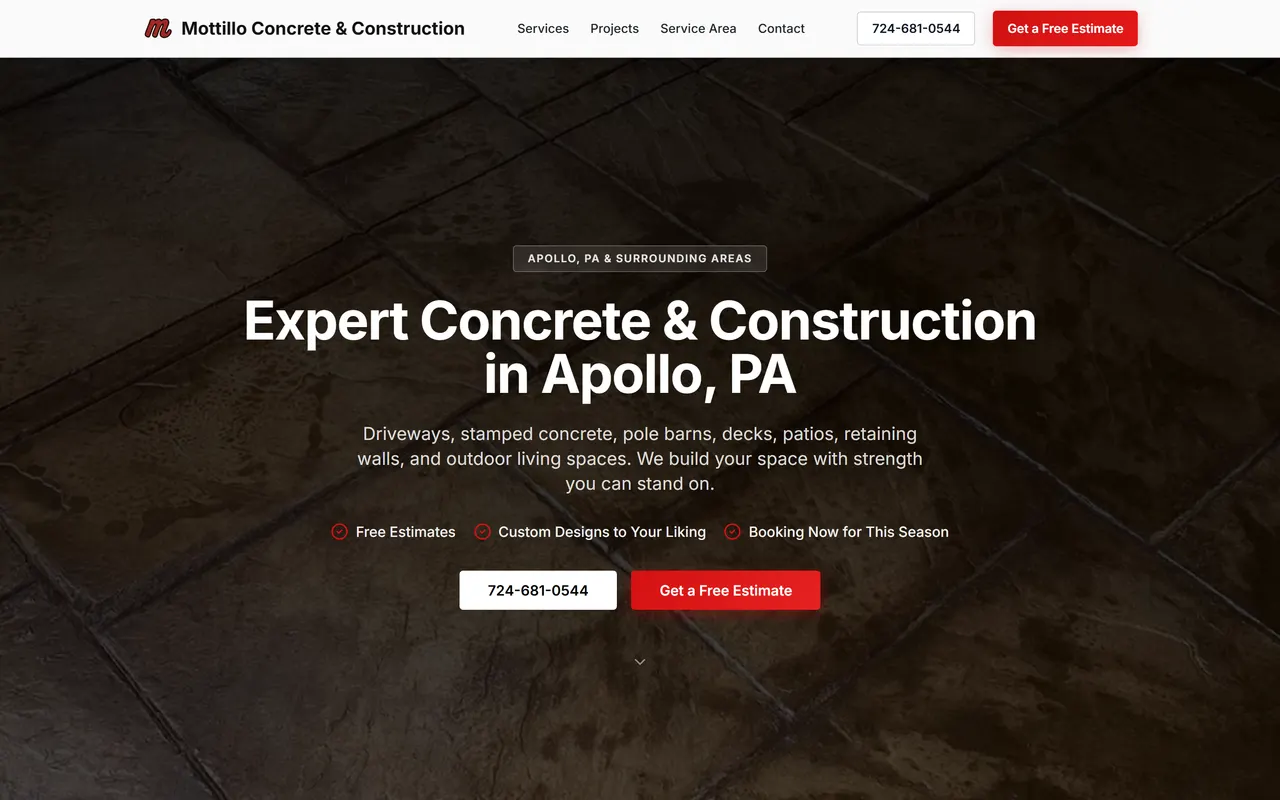
The site is live. Open it and judge the work yourself.
What Contractors Ask Us First.
When should I start if I want a full spring?
The fall before. Homeowners decide in late winter and early spring, and the pages, photos and profile that win those decisions need weeks in the index before the decisions start. Starting in April means paying for work that lands after your season has already been booked by somebody else.
My Facebook page is full of finished jobs. Do I still need a website?
Yes, for two reasons. A homeowner comparing three contractors wants to scroll a portfolio without an account, an algorithm or a sign in wall, and a Facebook page is close to invisible in a Google Maps result. Keep posting there. The site is where the same photos get organized by job type, town and material so a stranger can find the one that looks like their yard.
My customers search for landscaping when they want a patio. What do I do about that?
You cover both words. Hardscaping, landscaping, concrete, cement, pavers and masonry all get typed by people who want the same job done. We write pages that use the words homeowners use and set the Google Business Profile categories and services so you show up on the search rather than only on the correct term.
Can you get me work four towns over?
It is a different job from ranking at your own address, and it is slower. Google weighs how close you are to the person searching, and that is the one thing nobody can change. Ranking outside your immediate radius comes from pages built for those towns, real jobs photographed and named there, reviews that mention them, and steady authority work. It is achievable, but anyone who tells you it is fast is selling you something.
What do you need from me?
Photos. That is most of it. Before and after shots of your own jobs, the town they were in, and roughly what the work was. Everything else is ours. You should be pouring, not writing website copy.
Have you built for a concrete and construction company before?
Yes. Mottillo Concrete and Construction, in the Apollo area northeast of Pittsburgh. We built their site and we run their Google Business Profile, sold the way this trade sells: a project gallery with a free estimate attached to it. The site is live and clickable, and it is on our work page if you want to walk it before you call us.
Let Us Look at Your Season Before You Book It.
Send us your site and your Google profile and we will tell you what a homeowner comparing three contractors sees, where you disappear on the map, and what would have to change before the spring decision window. You keep the answer whether or not you ever hire us. If the timing is wrong, we will say that too.