Marketing for Specialty Food and Retail Shops.
You are running two storefronts. One has a door on a street in a town where people already know your name, and the other is open at three in the morning to somebody four states away who moved out of that town twenty years ago. Both are fed by the same two things: photographs of what you make, and a reputation that a chain store cannot buy, copy or open a branch of.
The Door on the Street and the One That Never Closes.
Most small shops treat the website as a poster for the real business. It is the second location. It has different hours and a different catchment, and it sells to people who will never stand in the first one. Run properly the two feed each other, and the shop that understands that stops being limited by how many people drive past it.
The Shop Sells the Website
Everybody who walks in is a potential online customer for the rest of their life. A card in the bag, the address on the receipt and a reason to sign up turn one visit into a list you can write to in November when they are shopping for gifts.
The Website Sells the Shop
Somebody planning a Saturday looks you up first. Hours that are right, photographs taken this year and a reason to make the drive are what turn a search into a person standing at your counter with a basket in their hand.
They Are Measured Differently
Online sales are countable to the cent and the walk-in is not, which is why shops keep concluding the website earns nothing. Direction requests, calls from the profile and people mentioning a photo at the counter are the real numbers.
Your Age, Your Recipes and Your Town Are the Only Unfair Advantage You Have.
A chain will beat you on price, on shelf space, on opening hours and on advertising budget. There is exactly one column where it cannot compete at all, and small shops routinely leave that column blank because being the oldest thing on the street feels ordinary when you grew up in it.
Say How Long, and Say Who
Seventy-five years, three generations, the original recipe, the same building. Those are not sentimental details. They are the reason somebody chooses you over a supermarket shelf, and they belong on the first screen a visitor sees.
Names matter as much as years. The person who makes it, the family who started it, the recipe that came from a grandmother. A buyer who can name somebody at your shop is not comparison shopping any more.
It is also the part an AI answer can quote back to somebody asking where to buy a thing locally. A date and a name are facts an assistant can repeat. An adjective is not.
Made Here Is a Claim With Teeth
Where a thing is made is one of the few product details buyers still slow down for, and it is the one most small producers state once in passing and never again. Put it on the product, on the page and in the photographs.
Show the making. The kitchen, the copper pot, the hands, the tray coming out. Process photography does more for a food brand than a styled product shot, because it shows the thing being made, which is the sentence you are asking somebody to believe.
The same material carries the whole year: the site, the online store, the profile, the social posts and the packaging all pull from one shoot instead of five.
Turning that history into a look that fits it is our branding work, and making those facts machine readable so an assistant repeats them correctly is the AI search side of it.
The Photograph Is Doing the Job the Sample Tray Does in the Shop.
In the store you can hand somebody a piece and the sale makes itself. Online you get one image and about two seconds. On a food site the photograph is the product, and it is the single biggest gap between shops that sell online and shops that have an online store nobody buys from.
Shoot the Product Properly, Once
Every item, on a clean surface, in even light, from the angle that shows what it is. This is the boring half and it is not optional, because a shop with one good photo and thirty bad ones looks like a shop that only makes one good thing.
Then Shoot the Making of It
Hands, trays, the pot, the mess, the person who has done it for thirty years. Process photography is what a chain cannot fake and a stock library cannot supply, and it does more selling than any adjective you could put underneath the price.
Photograph the Shop Itself
The window, the counter, the shelves and the street outside. Somebody deciding whether to drive twenty minutes wants to see where they are going, and the Google profile eats these constantly and rewards a shop for feeding it.
Shoot Once, Use It All Year
One proper session produces the site, the store, the profile, the posts, the packaging and the gift guide. Shops that shoot on a phone as they go end up with a library that never quite matches itself and a brand that reads as accidental.
Foot Traffic Is a Map Result Now.
The sign above your window stopped being your main advertisement some time ago. What decides whether a stranger in town finds you is a search on a phone, and what decides whether they choose you over the other two results is a set of photographs and a review count. Here is the sequence.
- The searchChocolate shop, bakery, butcher, gift shop, plus the town. Three businesses show on the map and the rest may as well not exist. Your categories, your hours and your photo count decide that placement far more than your website does.
- The glanceThey look at the pictures and the star rating and nothing else for the first few seconds. Photographs taken this year of the actual products beat a logo and an empty storefront shot every single time, and reviews with the town named in them beat older ones.
- The driveHours have to be right, especially on a holiday weekend, because a wasted trip becomes a one star review about something that had nothing to do with what you sell. Directions, parking and the entrance in a photograph all remove a small reason not to come.
- The counterA first visit is the cheapest online customer you will ever get. Ask for the review before they leave, put the site in the bag, and give them a reason to join the list so November's gift season has somebody to write to.
That whole sequence is the profile and the map, which is Google Business Profile work and local SEO, with the review habit underneath it in reviews and reputation.
Most of the Year Is Decided by Six Weeks and a Shipping Deadline.
Specialty food is a gift business whether or not you think of it that way, and gifts are bought against dates. The holidays, Easter, Valentine's and Mother's Day carry the year, and every one of them has a shipping cut-off that arrives before the demand does.
Publish the Cut-Off Early
The last day to order for delivery belongs on the site in November, not in a panicked post in the third week of December. Orders in this trade are lost to people deciding too late far more often than they are lost on price.
Build the Gift Guide in Advance
Bundles, price points, corporate quantities and something under twenty dollars, photographed and priced before the season starts. A shop putting that together in December is a shop selling whatever happens to be on the shelf that morning.
Sell the Quiet Stretch on Purpose
Corporate gifts, wedding favors, local business accounts and a subscription for the people who moved away are steady work through the flat months. Almost nobody in this trade advertises for any of it, which is exactly why it is available.
The Setup for a Specialty Food Shop, Piece by Piece.
These are the same services 945 Studios runs for every business, ordered and aimed at a shop with a counter and a shipping label. Every one of them carries its price on its own page.
A Store That Handles Orders
Products, options, inventory and shipping in one place, so an online order is something the shop fulfills rather than something it has to reconstruct out of an email and a phone call.
Photography of the Real Thing
Every product shot properly, plus the making, the hands and the shop itself, in one session that then feeds the site, the store, the profile, the packaging and a year of posts.
The History, Said Out Loud
How long, whose recipe, made where and by whom, written as plain facts on the pages people actually land on. Almost nobody in a hurry opens an About page.
A Profile That Earns the Walk-In
Categories, hours, holiday hours, products and current photographs kept up to date, because for a shop the map result is frontage and it is doing more work than the sign above the window.
Reviews, Asked For at the Counter
A simple habit at the point of sale and an automatic request after an online order, plus replies to what comes back, because for a shop the star rating is the price of being chosen.
A List Worth Owning
Everybody who has bought from you, in the shop or online, kept somewhere you can write to in November with a gift guide and a shipping cut-off attached to it.
If the site and the store are the missing piece, that is our web design work. If the look no longer fits the history, start with branding, and every service we run is listed with what it covers.
We Build for a Specialty Food Shop in the Kiski Valley.
Sweetlane Chocolate Shop is a 945 Studios client, and the whole build is written up start to finish rather than summarized into a logo on a wall.
Sweetlane Chocolate Shop, Vandergrift
A Vandergrift chocolate maker with seventy-five years behind it and a website that did not show it. Seventy-five years of making chocolate by hand, and none of it was on the old site.
New logo and type keeping the classic feel, a responsive site with a 3D view of the shop, over two hundred photos and videos shot and edited into a proper brand library, and an e-commerce backend that made online orders and inventory manageable. Built in four weeks.
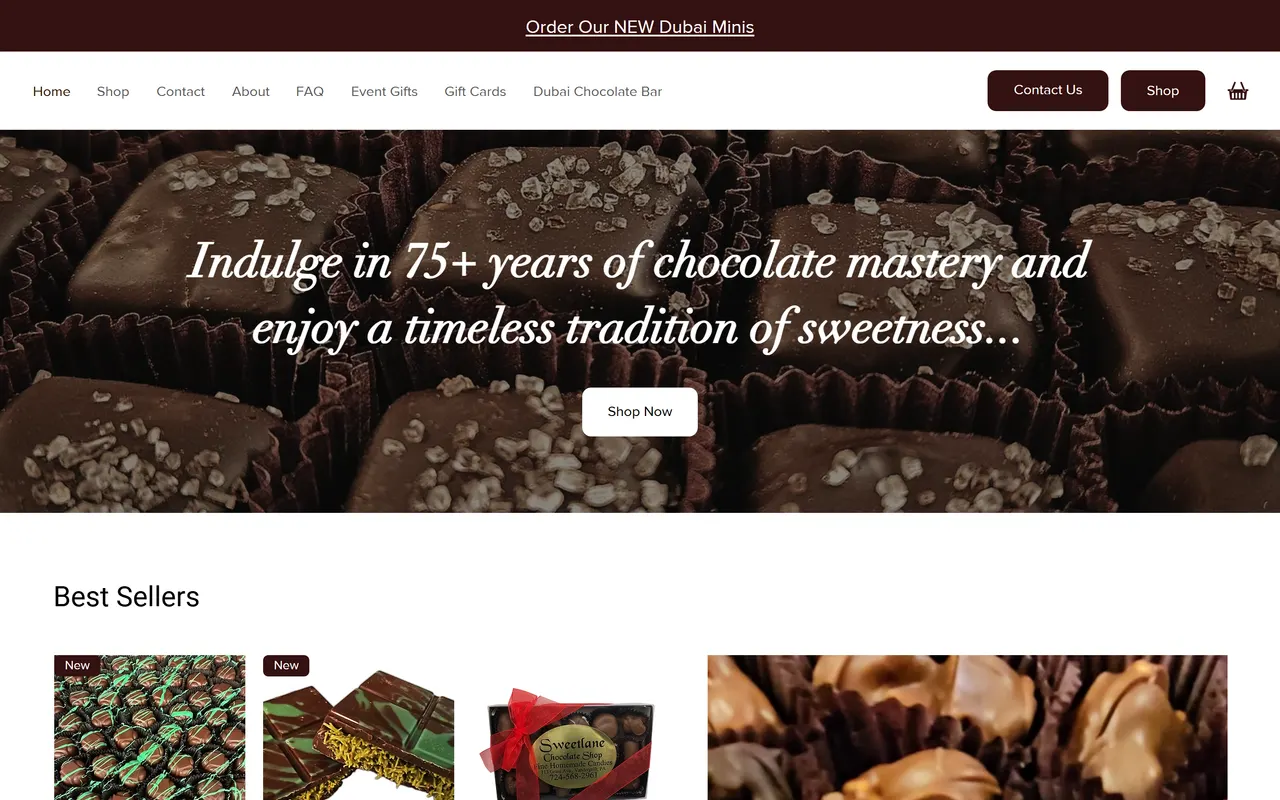
The site is live. Open it and judge the work rather than taking our word for it.
What Shop Owners Ask Us First.
Does a small food shop really need an online store?
It needs one if anybody has ever asked you to mail something. That question is the signal, and most shop owners have been answering it by hand for years without counting how often it comes up.
An online store turns the people who moved away, the corporate gift order and the person who saw a photograph at midnight into revenue that does not need the door to be open.
What brings people through the door of a local shop now?
A map result and a photograph, in that order. Somebody in town searches for what you sell, three businesses appear, and the one with current photos and recent reviews gets walked into.
Foot traffic stopped being about the sign above your window a long time ago, and the Google profile is now the most valuable piece of frontage a small shop owns.
How much does photography matter for a food shop?
It is the sale. Nobody can taste through a screen, so the photograph has to do everything the sample tray does in the shop. That means real product, shot properly, on a clean surface, with the hands and the mess of making it somewhere in the set too.
A shop with weak photographs is a shop asking people to take its word for the thing they cannot try.
How does a small shop compete with a chain or a big online brand?
By selling the things they are structurally unable to sell. How long you have been doing it, whose recipe it is, that it is made in the back of this building by people with names.
A chain can beat you on price and shelf space every day of the week and it can never manufacture seventy-five years in one town.
What changes once we start shipping?
Your market stops being the towns you can drive to and your calendar gets a hard edge. Shipping food means packaging, weather, and a cut-off date that lands well before the holiday it serves.
Publish that date early and loudly, because the orders you lose are almost never lost on price, they are lost to somebody deciding too late.
How should a seasonal shop handle the quiet months?
Build in them and sell gifting through them. The holidays, Easter and Valentine's are decided by work done months earlier, so the quiet stretch is when the photography, the store and the list get built.
In between, the corporate gift order, the wedding favor and the local business account are steady work that nobody in this trade advertises for.
Open the Second Storefront.
One conversation about what you make, how far people already travel for it, and how often somebody asks whether you can mail it. We come back with a short list of specific opportunities and what it would take to have them running before your next gift season. You keep the list either way, and whether you hire us for any of it is entirely your call.