Marketing for Event Venues.
Your website is the reservation desk, and it is open at eleven at night when a parent is finally sitting down to plan a birthday. This page is about building a site that takes the booking on its own: capacity and availability in the open, prices printed, waivers signed before anybody arrives, and a calendar worth coming back to.
Most Venue Websites Are a Poster for a Phone Number Nobody Wants to Call.
A venue is one of the few local businesses where the whole transaction can happen on the site, start to finish, without a conversation. Most of them do the opposite: photographs, a paragraph about the space, and a form that promises somebody will be in touch. That form is where the booking goes to die, at the exact moment the buyer was ready.
They Are Ready Right Now
Somebody looking at a venue at night has already decided to have the party. They are not browsing. Handing them a contact form at that moment turns a booking into a task on your list and a wait on theirs, and waits get filled by other venues.
A Phone Call Is a Barrier
The buyer planning a children's party is often doing it after bedtime with a phone in one hand. Calling during business hours means remembering tomorrow, and tomorrow they open the next venue's site and book the one that let them.
You Are Running a Call Center
Every question the site failed to answer arrives as a call, and each one costs staff time you priced into nothing. A site that answers capacity, price, availability and what is included plainly is a member of staff who never takes a day off.
Capacity, Availability, Price, and What Is Included.
Every venue booking turns on the same four questions, and almost every venue site answers one or two of them. The buyer wants all four before they commit. They are trying to avoid the one thing worse than picking the wrong venue, which is picking it and finding out afterward.
How Many Fit, and When Is It Free
Capacity is the first filter, and it has to be a number on the page. Say how many people the room seats and how many it holds standing, per space, in text a phone can read without pinching at it.
Availability is the second, and it is the one that separates a real booking system from a picture of one. If a buyer can see that the Saturday they want is open, the decision collapses into a single click.
Hiding both behind an inquiry form asks the buyer to spend a day finding out something you already know, and most of them will not spend it on you.
What It Costs and What Comes With It
A parent planning a party has a number in mind before they open your site. Printing your packages keeps that booking in play. It sorts the people who were never going to book from the ones who are ready to.
What is included matters as much as the price itself. Two hours or three, tables and chairs, a host, cleanup, whether food can be brought in, and what the deposit is to hold the date.
Write it as a list a person can compare against the other two venues open in their other tabs, because that comparison is happening whether or not you make it easy.
Printing the price is a conversion decision before it is a marketing one, which is conversion rate work, and the site that carries it is our web design work.
From Open Date to Signed Waiver Without a Phone Call.
A booking that completes itself is four steps, and every one of them is a place a venue loses somebody. Built properly the whole thing runs while you are locking up, and what you get in the morning is a reservation, a deposit and a signed waiver rather than three voicemails.
Show the Calendar
Real availability on the screen, by space and by time slot, with the dates already taken grayed out rather than hidden. A buyer who can see Saturday is open stops shopping. A buyer who has to ask starts comparing you against the venue that showed them.
Take the Deposit at the Decision
The moment somebody picks a date is the moment they are most willing to pay. A card field there converts far better than an invoice sent the next morning, and a held date with money against it is a booking rather than an intention.
Send the Waiver With the Confirmation
Every guest signs on a phone before they leave the house. A clipboard at the door is a queue, and a queue at the start of a party is the first thing a parent remembers about your venue. Store it against the reservation and ask once.
Ask While They Are Still Happy
The review request goes out the evening of the party, not a week later. So does the offer that brings them back for open play. Both are automatic, because nobody resetting a room at four on a Saturday is going to remember to send them.
Three Tabs, One Phone, About Nine Minutes.
Venue buyers do not shop the way contractors' customers do. There is no vetting period and no second visit. They open three venues in a row, and the one that answers fastest usually wins on nothing more than that. Here is the sequence, and where each venue tends to fall out of it.
- The searchA map result for the town, or a name somebody dropped in a parents group. Both land on the same page, so the profile and the site have to agree on the hours, the address and what you even are, because a mismatch reads as closed.
- The first nine secondsThey are scanning for a number of people and a price. Photographs of a lovely room do not survive that scan on their own. Put the capacity and the package price where a thumb lands and the other two tabs start losing.
- The comparisonNow it is your packages against theirs, side by side. What is included decides this, not the headline price, and the venue that spelled it out plainly reads as the honest one even when it is the more expensive of the three.
- The bookingThey pick a date, pay a deposit and get a confirmation with the waiver attached. If any part of that needs you to be awake, the booking waits, and a booking that waits until morning is a booking somebody else took at midnight.
Being in the map result at the top of that sequence is local SEO and the Google Business Profile, and the confirmations and reminders underneath it are automation and CRM.
A Good Party Sells the Next Four Better Than Reach.
A venue is one of the rare local businesses where the customer brings thirty other customers with them and hands you their name at the door. Most venues let that walk out at the end of the afternoon. The families in the room today are the cheapest bookings you will ever take, and they are already on the guest list.
The Guest List Is a Customer List
Every party fills your building with parents of children the same age as the one having the party. They have seen the room, watched their child enjoy it, and are the easiest booking in the business. Capture the name at the waiver and write to it later.
Parents Talk to Each Other
One group chat carries more weight in this trade than any advertisement, and it moves fast in both directions. Which means the review, the reply to the review, and how the last complaint was handled are marketing spend whether you treat them that way or not.
Give Them a Reason Between Parties
Nobody books a birthday twice a year, but open play, camps, holiday sessions and toddler mornings fill the same room on the quiet days. An events calendar people check is what keeps a venue in mind between the two occasions they need one.
The Setup for an Event Venue, Piece by Piece.
None of these are unique products. They are the same services 945 Studios runs for every business, ordered and pointed at a booking that has to complete itself at night. Every one of them carries its price on its own page.
A Site That Takes Reservations
Real availability by space and time slot, a deposit taken at the moment of the decision, and a confirmation that goes out on its own. The booking finishes without you being awake for it.
Packages Printed With Their Prices
Every package with its price, its length, its headcount and what is included, written as a list a parent can hold against the other two venues they have open in other tabs.
Digital Waivers on the Booking
The waiver goes out with the confirmation, gets signed on a phone before anyone leaves home, and is stored against the reservation.
An Events Calendar Worth Checking
Open play, camps, holiday sessions and seasonal events on one page that updates itself, giving people a reason to come back to the site on the days they are not booking a party.
A Profile Built for the Map
Google Business Profile categories, services, hours and photos set for a venue, because the map result is where most first visits to a venue site begin.
Reviews and the Guest List
An automatic review request the evening of the party, replies to what comes back, and every guest name captured at the waiver kept for the offer that brings the family back.
If the site is the missing piece, that is our web design work. If the reviews are, reviews and reputation is where to start, and every service we run is listed with what it covers.
We Build for an Event Venue in the Kiski Valley.
The Sia Center is a 945 Studios client, and it is the build that taught us how much of a venue site has to work without anybody picking up the phone.
The Sia Center, Vandergrift
An indoor playground and event venue in Vandergrift, running open play, birthday parties and private events for children up to eight.
This one is a booking engine wearing a website: online reservations, digital waivers, an events calendar and party packages all have to work without a phone call. Every decision on the build came back to the same question, which is whether a parent could finish the whole thing on a phone after the children were in bed.
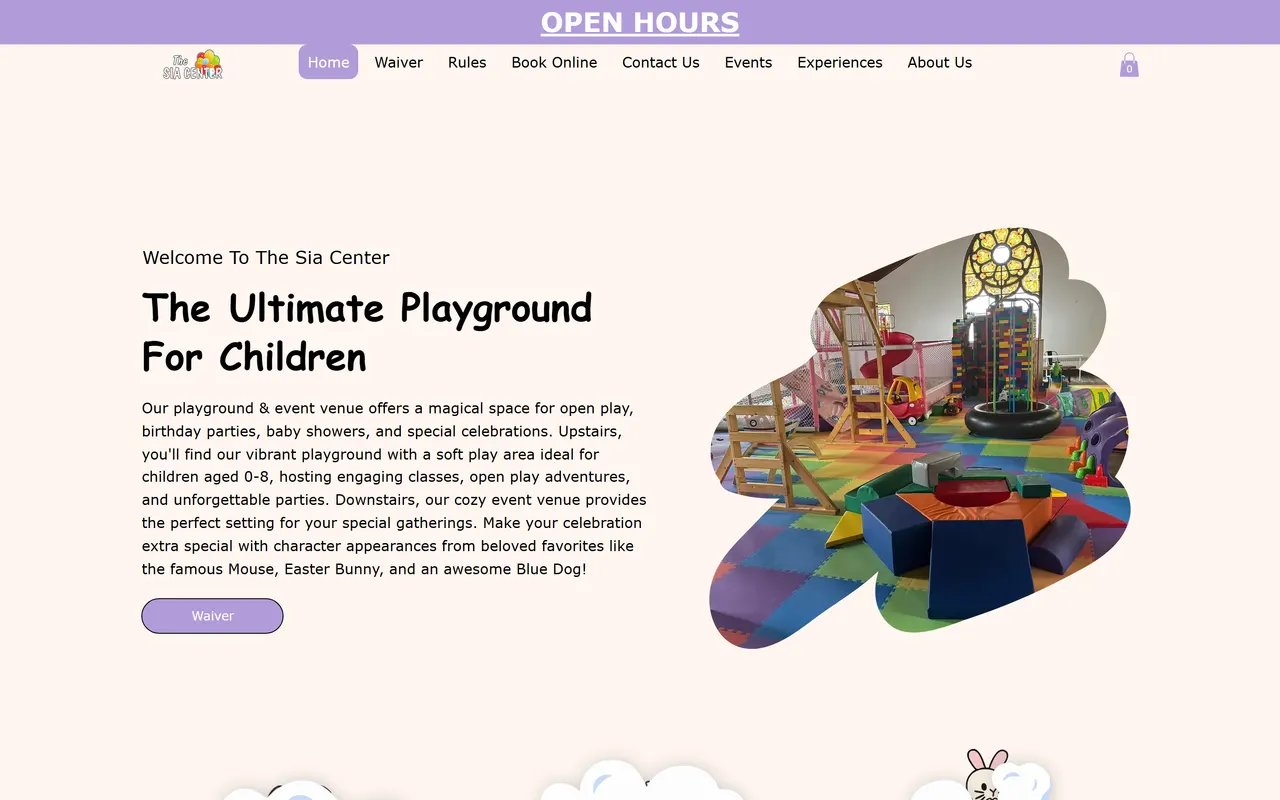
The site is live. Open it and judge the work for yourself.
What Venue Owners Ask Us First.
What does an event venue website need to do?
Take the booking. Everything else on it is decoration around that one job. A venue site is not a brochure that leads to a phone call, it is the reservation desk itself.
The four things it has to answer before anybody will use it are how many people fit, which dates are open, what it costs, and what is included in that price.
Should an event venue publish its pricing?
Yes, and hiding it costs more bookings than it protects. A parent planning a party has a number in their head before they open your site, and a venue that will not print one gets closed and replaced with the venue that did.
Publish package prices with what each one includes, name the deposit, and let the unusual events be the ones that call.
Do we need online booking or is a contact form enough?
Online booking, if the event is a package you sell over and over. Birthday parties, open play and standard room rentals should be reservable at eleven at night without you in the loop, because that is when parents plan.
Keep the form for the unusual bookings, the corporate day and the full buyout, where a conversation genuinely earns its place.
How do we handle waivers without a clipboard at the door?
Send the waiver with the booking confirmation and let it be signed on a phone before anyone arrives. A clipboard at the door is a queue, and a queue at the door of a party is the first thing a parent remembers.
Signed digitally, stored against the reservation, and asked for once.
How do people find an event venue in the first place?
A map search naming the town, a recommendation in a parents group, and the events calendar people already check. Those three feed each other.
The map result gets you seen, the recommendation gets you trusted, and a calendar worth checking gets people back on the site between bookings.
Is a new customer or a repeat booking worth more to a venue?
The repeat booking, by a distance. A family that had a good party comes back for open play, books the next birthday, and tells a group chat full of parents with children the same age.
Reach is the expensive way to fill a room. The cheap way is a guest list you kept, and a reason to write to it.
Let the Site Take the Booking.
One conversation about which of your spaces sell themselves, which questions your staff answer on the phone all day, and what happens when somebody wants to book a Saturday at midnight. We come back with a short list of specific opportunities and what it would take to have them running before your next busy season. You keep the list either way, and whether you hire us for any of it is entirely your call.